
Africa Is Now South Africa's Biggest Agricultural Customer. Most Exporters Still Behave Otherwise.
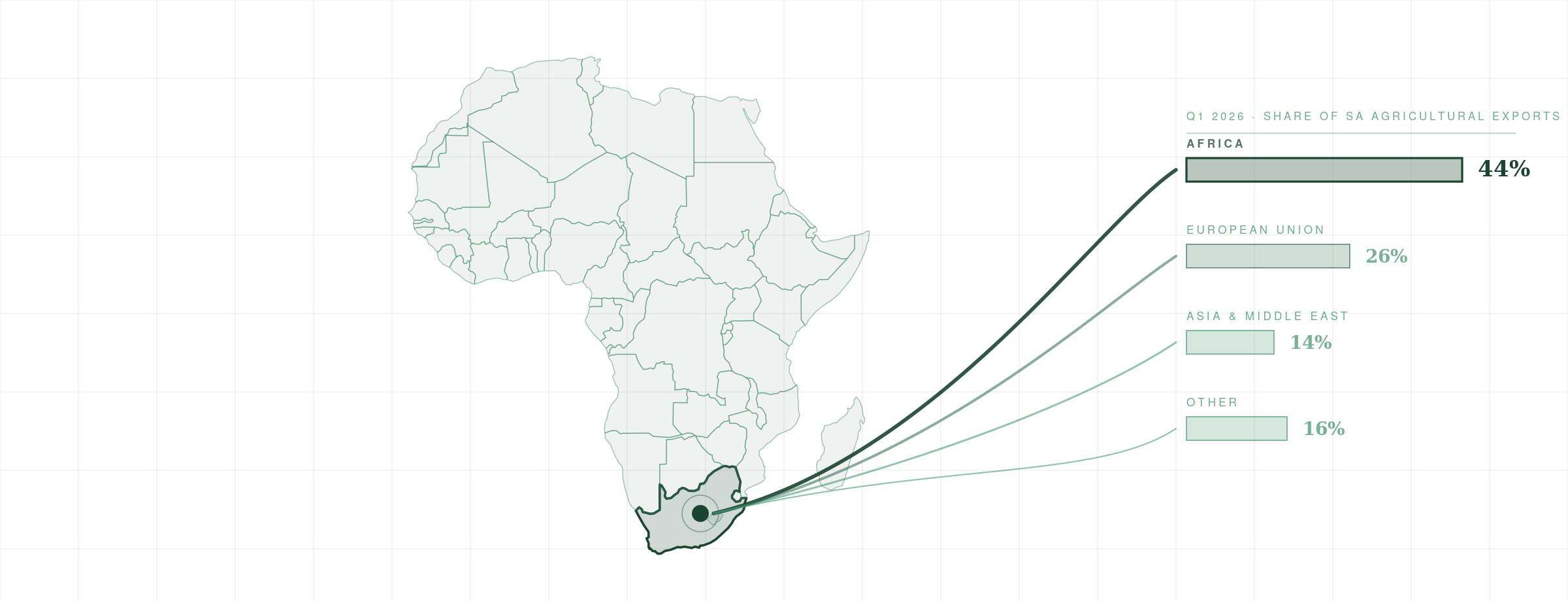
South Africa's agricultural exports totalled US$3.7 billion in the first quarter of 2026, up 11% year on year. It was a first-quarter record, and it delivered a trade surplus of roughly R33 billion — around 40% of the country's entire trade surplus for the period.
The number that deserves more attention than it got is this one: the African continent accounted for 44% of that value. The European Union, long treated as the destination that matters, came second at 26%. Asia and the Middle East together made up 14%.
Maize, apples and pears, soybean, sugar, fruit juices, soybean and sunflower oil, and wine led the African list. These are not marginal categories.
The habit gap
Walk into most South African export operations and the mental map has not caught up. Sales structures, trade show budgets, packaging decisions, language capability and relationship investment still tilt heavily toward Europe and the United Kingdom.
There are understandable reasons. European buyers pay in hard currency, have predictable payment behaviour, and operate within legal frameworks South African exporters have decades of familiarity with. African markets have historically meant slower payment, harder logistics, thinner information and higher counterparty risk.
But the premise is drifting out of date, and the pace of that drift is the actual story.
What has changed on the ground
Three structural developments have moved intra-African trade from aspiration toward something operationally usable.
Payments. The Pan-African Payment and Settlement System is now in force, and is projected to cut foreign exchange costs on intra-African transactions by somewhere between 20% and 30%. Anyone who has tried to move money between two African currencies via a correspondent bank in London understands why this matters more than another tariff schedule.
Tariffs. Under the AfCFTA Protocol on Trade in Goods, member states have committed to liberalising at least 90% of tariff lines. Non-sensitive lines phase down over five years for non-LDCs and ten for LDCs. Rules of origin coverage has passed 90%, though textiles, clothing and automotive remain under negotiation — agrifood is comparatively well settled.
Composition. Afreximbank forecasts intra-African trade reaching US$230 billion in 2026, up 10% from US$210 billion in 2025. More telling than the headline is the mix: manufacturing and agrifood are expected to account for 48–50% of intra-African flows this year, up from 46% in 2025, offsetting a slowdown in raw commodity trade.
That last shift is the one to watch. Intra-African trade is becoming a trade in processed and value-added goods rather than raw material. That is precisely the segment where a premium South African producer has something to sell.
The honest caveats
We are not going to pretend the AfCFTA is finished. Implementation has been slower than its advocates hoped. The Guided Trade Initiative — which lets specific country pairs with compatible tariff offers and rules of origin start trading under AfCFTA terms — remains a proof of concept rather than a continental reality. Non-tariff barriers along key corridors are being dismantled gradually, not eliminated.
Anyone selling AfCFTA as a solved problem is selling something.
The more useful framing is that the friction is falling faster than most exporters have updated their assumptions. The gap between how difficult African trade actually is in 2026 and how difficult exporters *believe* it is has widened — and gaps of that kind are where margin lives.
Logistics remains the real constraint
The Q1 figures came with a caveat that anyone in the sector will recognise. Port of Cape Town efficiency has improved from its worst period, but delays persisted through the peak table grape export window at the end of 2025 and into 2026. Some growers and exporters rerouted volumes that would normally move through Cape Town to Eastern Cape ports.
This is worth stating plainly because it cuts against the continental opportunity. It does not matter how favourable a tariff schedule is if the container sits. For anyone building an African export book, port risk deserves to be modelled as seriously as currency risk — and routing flexibility is worth paying for before you need it.
What this means practically
For a South African producer of premium food or beverage, three things follow.
Nigeria and Kenya deserve a real look, not a token one. Nigeria's upper-middle-class consumer base and Kenya's tourism-driven hospitality sector are both underserved for premium South African product. These are not development markets. They are commercial markets with buyers who will pay for quality and who are currently being courted mainly by European and Gulf suppliers.
Rules of origin are the detail that determines whether preference is real. AfCFTA preferential tariffs only apply to goods meeting the rules of origin criteria — substantial production or transformation within Africa. For most South African agrifood this is straightforward, but it needs documenting properly at the outset rather than argued at the border.
Local partners are not optional. Every functioning African trade corridor we know of runs on a relationship with someone who understands the destination market's distribution, payment culture and regulatory quirks. This is not a market you enter by email.
Why we built around this
Terra Vero operates four trade corridors, and two of them are intra-African by design: East Africa into South Africa for specialty coffee, and South Africa into West and East Africa for wine and artisan products.
That was a deliberate choice, and a slightly contrarian one when we made it. Most South African trading houses of our size point at Europe. We think the more interesting question is who will have built the relationships, the payment routes and the regulatory knowledge for African corridors when the friction finishes falling.
The trade data is already there. The infrastructure is arriving. The habits are the last thing to change — which is exactly why there is still room.
Sources: Agricultural Business Chamber of South Africa (Agbiz) Q1 2026 trade data; Bureau for Food and Agricultural Policy Agricultural Trade Brief; Afreximbank, African Trade and Economic Outlook 2026; AfCFTA Secretariat Protocol on Trade in Goods; AfCFTA 2024–2025 Implementation Report.